CardioPredict AI Heart Disease Risk Prediction Using a Four-Model Ensemble (Flask + Scikit-learn)
Heart disease risk predictor that combines four algorithms — Random Forest, Gradient Boosting, Extra Trees and a neural network — into one voting classifier. Flask web interface included.
Technology Used
Flask | Python | Scikit-learn | Bootstrap | JavaScript | HTML5 | CSS3 | Pandas | NumPy | Matplotlib | Seaborn | Joblib | Machine Learning


Project Files
CardioPredict AI predicts heart disease risk from a patient's clinical and lifestyle values. The part worth paying attention to is how it predicts: instead of training one model and shipping it, four different algorithms each make a call and a voting classifier combines them into a single answer.
Why an Ensemble Instead of One Model
Random Forest, Gradient Boosting, Extra Trees, and a neural network each have different blind spots. Random Forest and Extra Trees both build many decision trees but split them differently. Gradient Boosting builds trees in sequence, each correcting the last one's mistakes. The neural network finds patterns none of the tree methods look for.
Run them together through a voting classifier and the errors partly cancel out, because it is unlikely that all four are wrong in the same direction on the same patient. This is the standard argument for ensembling, and this project is a working demonstration of it — including the individual model scores, so you can show what each algorithm achieved alone versus what the ensemble achieved together.
That comparison is the strongest thing to talk about in a viva. Anyone can train a classifier. Explaining why four beat one is a better answer.
How It Differs From the Other Medical ML Projects Here
CodeAj has more than one Flask and Scikit-learn health project, and buyers regularly pick the wrong one.
MediPredict AI is a single-model breast cancer classifier using 30 cell-nucleus measurements from a lab report. One algorithm, one dataset, simpler code.
BreastGuard AI is a computer vision project — you upload an ultrasound image and OpenCV processes the pixels.
CardioPredict is the one to pick if your syllabus specifically covers ensemble methods, model comparison, or hyperparameter tuning. If it does not, one of the simpler two will be less work to explain.
The Machine Learning Pipeline
- Preprocessing — robust scaling to reduce the influence of outliers, which matters because medical readings like cholesterol have long tails
- Feature selection — narrowing the input set to the parameters that actually carry signal
- Individual training — each of the four algorithms trained separately with cross-validation
- Hyperparameter tuning — GridSearchCV searching parameter combinations per model
- Ensemble assembly — the tuned models combined into a voting classifier
- Serialisation — the final ensemble saved with Joblib so Flask can load it at startup
Input Parameters
The form collects 16 clinical and lifestyle values, including age, sex, resting blood pressure, serum cholesterol, chest pain type, and exercise-induced angina. These map to the standard feature set used in cardiovascular risk datasets, so if you later swap in a different dataset the input schema will mostly line up.
The Web Application
- Flask backend with the prediction exposed as an API endpoint, so the model can be called from something other than the form later
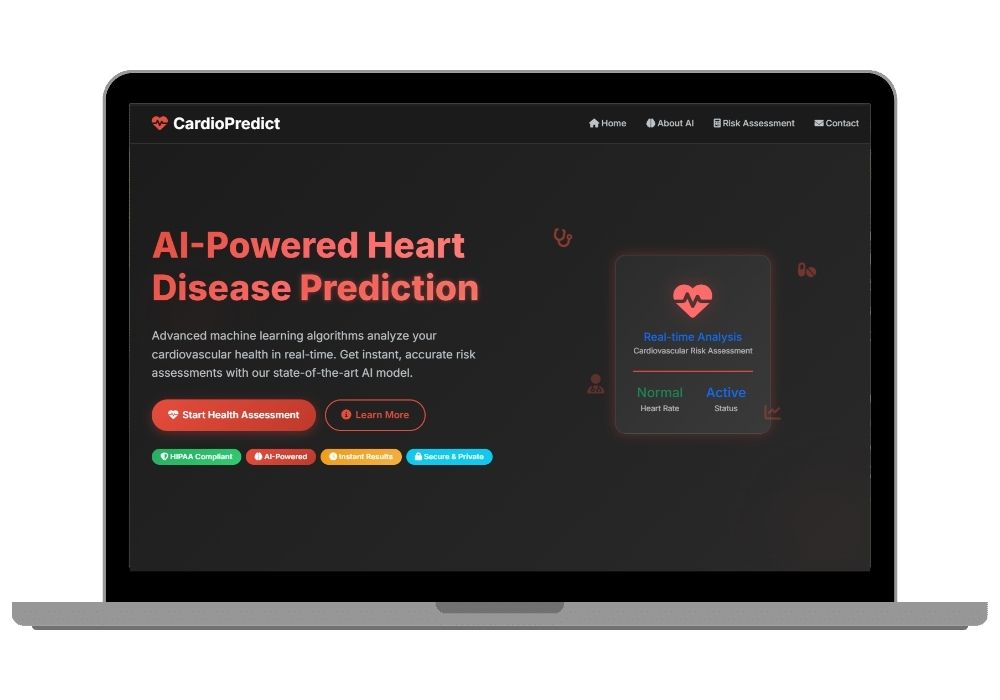
- Dark-themed Bootstrap interface — readable in low light, which is the actual reason clinical dashboards tend to be dark
- Risk visualisation — a meter and charts rather than a bare percentage, so the result is legible at a glance
- Risk factor breakdown — which inputs pushed the prediction up, not just the final number
- Validation on both sides — the browser catches obvious mistakes, the server catches everything else
- Responsive layout — the 16-field form reflows properly on a phone
Technology
- Backend: Flask (Python)
- Machine Learning: Scikit-learn — Random Forest, Gradient Boosting, Extra Trees, neural network, VotingClassifier, GridSearchCV
- Data handling: Pandas, NumPy
- Plots: Matplotlib, Seaborn
- Model persistence: Joblib
- Frontend: Bootstrap, HTML5, CSS3, JavaScript
What This Is Not
This is an academic project, not a medical device. It has not been clinically validated, it is not approved for diagnostic use, and no output from it should influence an actual medical decision. Say this plainly in your report — examiners tend to respect a student who understands the limits of their own model more than one who oversells it.
Where People Take It Next
Common extensions: adding SHAP values so each prediction comes with a per-feature explanation, replacing hard voting with soft voting weighted by individual model confidence, adding XGBoost or LightGBM as a fifth member, storing prediction history against user accounts, or retraining the whole pipeline on a regional dataset instead of the default one.
Frequently Asked Questions
Extra Add-Ons Available – Elevate Your Project
Add any of these professional upgrades to save time and impress your evaluators.
Project Setup
We'll install and configure the project on your PC via remote session (Google Meet, Zoom, or AnyDesk).
Source Code Explanation
1-hour live session to explain logic, flow, database design, and key features.
Want to know exactly how the setup works? Review our detailed step-by-step process before scheduling your session.
₹999
Custom Documents (College-Tailored)
- Custom Project Report: ₹1,500
- Custom Research Paper: ₹1,000
- Custom PPT: ₹800
Fully customized to match your college format, guidelines, and submission standards.
Project Modification
Need feature changes, UI updates, or new features added?
Charges vary based on complexity.
We'll review your request and provide a clear quote before starting work.